
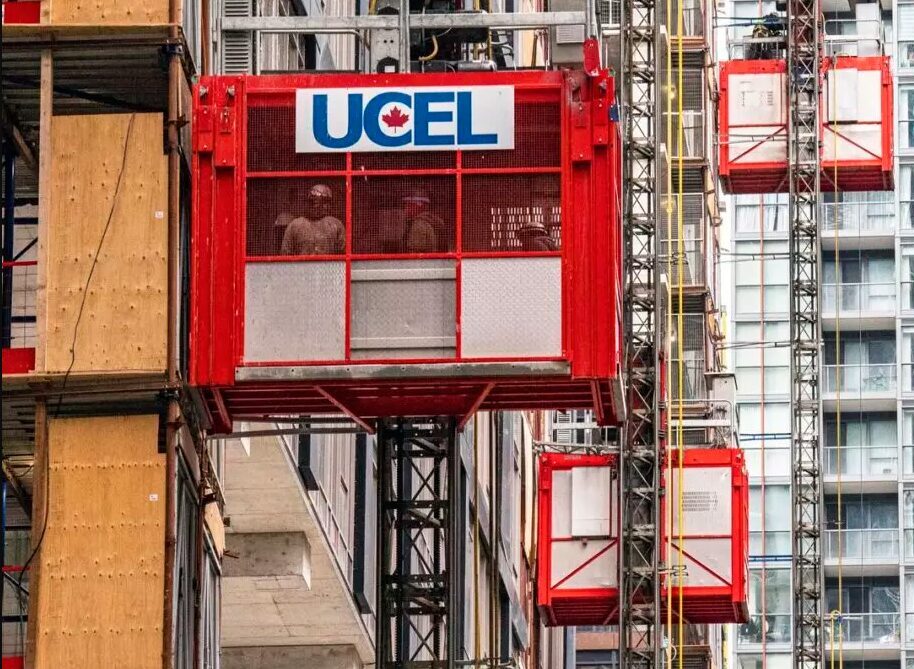
Cranes remain central to vertical movement on construction sites, but overreliance on them creates bottlenecks that disrupt schedules and workflows. As project density increases across Canada and the USA, cranes are often pulled in multiple directions at once. Material staging delays, queue buildup, and idle crews become routine outcomes when a single lifting resource is stretched too far.
These challenges highlight the need for a parallel lifting solution that handles repetitive vertical transport without competing for crane time. A construction material hoist addresses this gap by supporting continuous material flow while allowing cranes to focus on critical lifts.
Understanding Crane Limitations on Busy Construction Projects
Cranes are designed for heavy, complex lifts, not constant material cycling. When tasked with moving pallets, tools, and bulk supplies throughout the day, crane schedules quickly become congested. Each lift requires coordination, clearance, and downtime between movements.
On high-rise or multi-trade sites, relying solely on cranes slows progress. Material hoists for construction systems relieve this pressure by handling predictable transport tasks that do not require crane reach or rotation.
How a Construction Material Hoist Reduces Waiting Time
Waiting time often defines job-site inefficiency. Crews pause work while materials remain queued at ground level or stuck mid-transfer. A construction material hoist operates on a dedicated vertical path, allowing scheduled, repeatable movement without interference.
By separating material transport from crane operations, projects experience smoother sequencing and fewer work stoppages across floors.
Cutting Load Congestion with a Multi-Route Transport System
Load congestion forms when multiple trades depend on the same lifting route. Cranes create a single access point, while hoists introduce parallel movement paths. This multi-route approach prevents pileups at loading zones and landing areas.
A properly placed hoist for construction materials distributes traffic vertically, improving overall site circulation and reducing ground-level clutter.
Key Features That Make Construction Material Hoists More Efficient
Efficiency is driven by consistency. Construction hoists are engineered for frequent cycles, controlled stops, and predictable load handling. Features such as rigid mast systems, guided platforms, and rated capacities allow uninterrupted operation throughout the workday.
These characteristics make material hoists’ construction systems ideal for sustained material flow rather than intermittent heavy lifts.
When to Deploy a Material Hoist: Scenarios Where Cranes Struggle
Certain project conditions magnify crane limitations. Interior build-outs, facade work, mechanical installations, and staged material delivery all benefit from independent lifting systems. In these scenarios, cranes become overtasked while crews wait.
Deploying a construction material hoist during these phases restores balance and improves throughput without reworking schedules.
Cost and Time Savings from Reducing Crane Dependence
Crane time incurs high operational costs. Extended use of routine material transport increases costs without adding proportional value. Shifting repetitive lifts to hoists reduces crane hours and lowers indirect labor costs tied to waiting.
Over the course of a project, hoists for construction materials systems contribute measurable savings in both time and budget control.
Safety Improvements with a Construction Material Hoist
Congested lifting zones increase risk. When materials queue around cranes, ground-level hazards rise, and coordination errors become more likely. Hoists establish controlled loading areas and predictable travel paths.
A construction material hoist supports safer material handling by reducing congestion and minimizing unplanned movement around active lifts.
How UCEL Material Hoists Deliver Reliable, High-Capacity Lifting
UCEL Inc. designs lifting systems that support high-capacity, repetitive material movement on demanding sites. Engineered for stability, load control, and continuous operation, UCEL hoists integrate seamlessly into complex construction environments.
These systems allow material hoists’ construction workflows to remain consistent even during peak activity periods.
A Construction Material Hoist Is the Fastest Way to Reduce Delays and Improve Jobsite Flow
Crane congestion no longer needs to dictate jobsite pace. A construction material hoist creates a dedicated material transport channel, reducing waiting time and congestion and improving coordination across trades. UCEL Inc. delivers hoist solutions built for reliability and sustained performance on projects throughout Canada and the USA.
Connect with UCEL Inc. to deploy a hoist for construction materials that keeps crews moving and schedules intact.