Vertical access challenges increase significantly as structures grow taller and industrial facilities become more complex. Construction teams and plant operators require lifting systems that remain reliable under heavy loads, frequent use, and demanding site conditions. Conventional elevator systems often fail to meet these requirements during construction or in rugged industrial environments, leading to delays, safety risks, and inefficiencies. These challenges have driven widespread adoption of the rack and pinion elevator across high-rise and industrial projects in Canada and the USA. Designed for external mounting, precise control, and consistent performance, these systems support both personnel and material movement throughout different project phases.
What Is a Rack and Pinion Elevator?
A rack and pinion elevator is a mechanically driven vertical transport system that operates using a gear (pinion) engaged with a fixed toothed rail (rack). Unlike traction-based systems, movement is controlled directly through the gear mechanism, allowing stable operation at varying heights and loads. Rack and pinion elevators are commonly installed on building exteriors, industrial structures, and specialized towers where traditional elevator shafts are impractical. To learn more about how a rack and pinion elevator works, read our blog here.
People Also Ask
1. Where are rack and pinion elevators commonly used in construction and industrial projects?
Rack and pinion elevators are commonly used on high-rise building exteriors, industrial plants, refineries, power facilities, and large infrastructure projects. Their external installation, modular height expansion, and mechanical reliability make them suitable for construction phases, maintenance access, and long-term industrial operation.
2. Why are rack and pinion elevators preferred over conventional elevators during construction?
Rack and pinion elevators are preferred because they operate independently of building shafts, handle heavy loads reliably, and perform consistently in harsh environments. Their controlled movement, scalability, and reduced reliance on cranes make them better suited for active construction and industrial conditions.
Why High-Rise and Industrial Projects Rely on Rack and Pinion Elevators
High-rise and industrial projects demand lifting systems that remain functional during construction, maintenance, and long-term operation. Rack-and-pinion elevators provide consistent speed, controlled stopping, and dependable performance even in harsh weather or dusty environments. The modular design supports gradual height increases, making the rack and pinion lift well-suited for phased construction schedules and evolving industrial layouts.
High-Rise Building Construction Applications
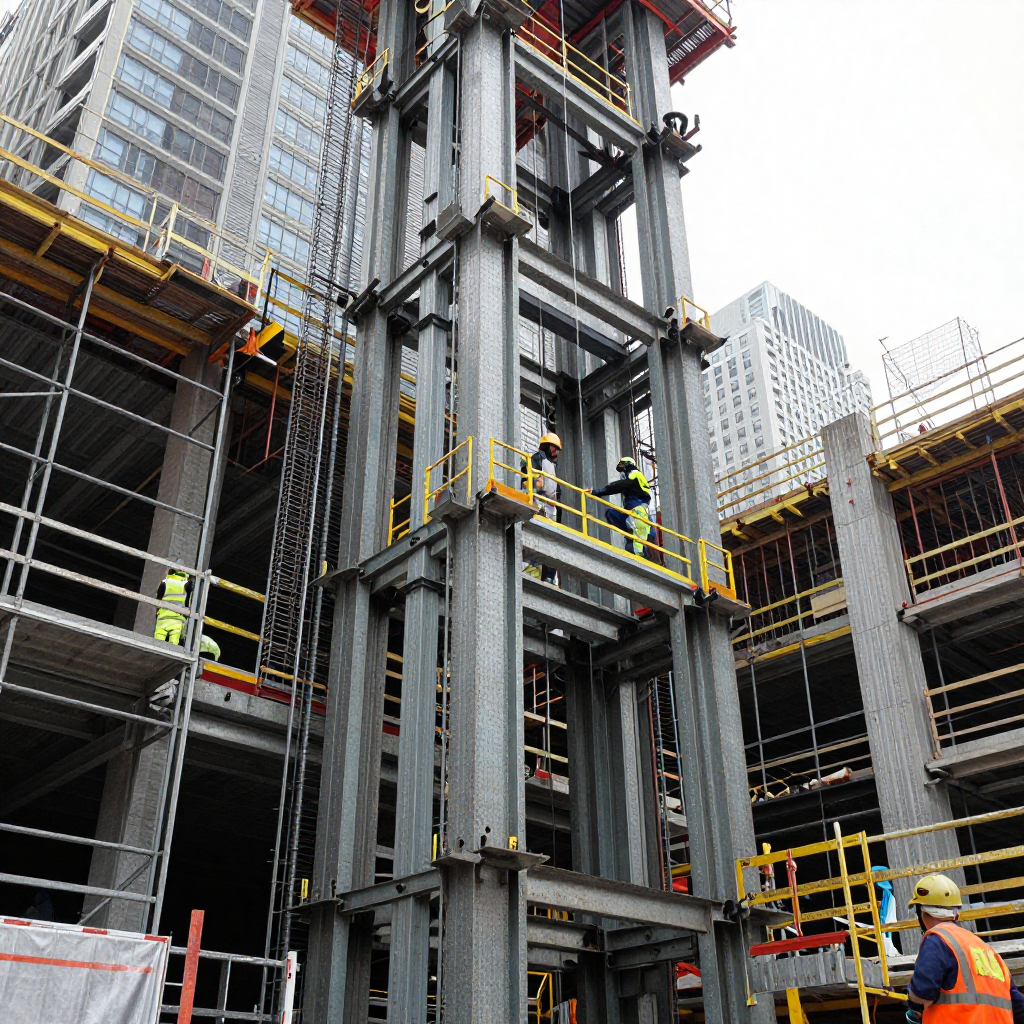
In high-rise construction, rack and pinion elevators are widely used to transport crews, tools, and materials between floors during structural, mechanical, and facade work. External installation allows uninterrupted interior construction while maintaining safe vertical access. The rack and pinion lift also supports extended operating hours, reducing congestion caused by cranes and temporary stair access.
Industrial Project Applications
Industrial facilities such as manufacturing plants, refineries, and processing facilities rely on rack-and-pinion elevators for vertical movement within confined or high-risk areas. These environments often involve heavy components, strict safety protocols, and continuous operation. The mechanical reliability of a rack and pinion elevator ensures predictable performance where downtime directly affects production schedules.
Infrastructure and Large-Scale Industrial Developments
Large infrastructure projects, including power plants, ports, and processing terminals, frequently incorporate rack and pinion elevators to serve towers, silos, and elevated platforms. The system’s ability to handle long travel heights and variable loads makes the rack and pinion lift effective for ongoing inspection, equipment servicing, and system upgrades in expansive facilities.
Temporary vs Long-Term Applications of Rack and Pinion Elevators
A key advantage of rack and pinion elevators is flexibility across project timelines. Temporary installations support construction and commissioning phases, while permanent systems remain in place for maintenance and operational access. This adaptability allows a single rack-and-pinion elevator solution to deliver value beyond initial construction.
Personnel Transport Applications
Personnel safety remains a primary concern in vertical transport. Rack and pinion elevators are engineered with controlled acceleration, emergency braking systems, and enclosed cabins to support safe crew movement. The rack and pinion lift enables consistent access to elevated work zones, reducing fatigue and minimizing reliance on temporary ladders or scaffolding.
Material Transport Applications
Material handling efficiency directly impacts project productivity. Rack and pinion elevators are designed to move tools, equipment, and construction materials vertically without compromising stability. Load-rated platforms and precise stopping accuracy allow the rack and pinion lift to support just-in-time delivery of materials across multiple levels.
Safety and Compliance Considerations Across Applications
Safety compliance is essential across construction and industrial environments in North America. Rack and pinion elevators are designed to meet applicable OSHA, ANSI, CSA, and local regulatory standards. Integrated safety features such as overload protection, limit switches, and emergency descent systems ensure the rack and pinion elevator supports safe operation across diverse applications.
How Rack and Pinion Elevators Improve Project Efficiency
Project efficiency improves when vertical transport remains predictable and uninterrupted. Rack and pinion elevators reduce crane dependency, limit material handling delays, and support parallel work activities. The consistent operation of a rack and pinion lift helps maintain schedules, especially in multi-trade and high-density project environments.
Common Mistakes When Applying Rack and Pinion Elevators
Improper application often leads to reduced performance and safety concerns. Common issues include underestimating load requirements, selecting incorrect travel speeds, or neglecting long-term usage planning. Choosing the wrong rack and pinion elevator configuration can result in operational bottlenecks and increased maintenance demands.
Choosing the Right Rack and Pinion Elevator for Your Application
Selecting the appropriate rack and pinion elevator requires careful assessment of project height, load capacity, duty cycle, and environmental conditions. Consideration must also be given to future expansion and compliance requirements. A properly specified rack-and-pinion lift aligns equipment capabilities with project demands from start to completion.
Aligning Rack and Pinion Elevator Applications With Project Performance
Successful vertical access planning depends on matching equipment to real-world operating conditions. Rack and pinion elevators continue to play a critical role in high-rise construction, industrial facilities, and large-scale infrastructure projects across Canada and the USA. With proven reliability and adaptable configurations, these systems enable safe, efficient vertical movement at every project stage. UCEL Inc. provides engineered rack and pinion elevator solutions designed for demanding construction and industrial environments. Connect with UCEL Inc. to identify the right system and keep projects moving without disruption.