
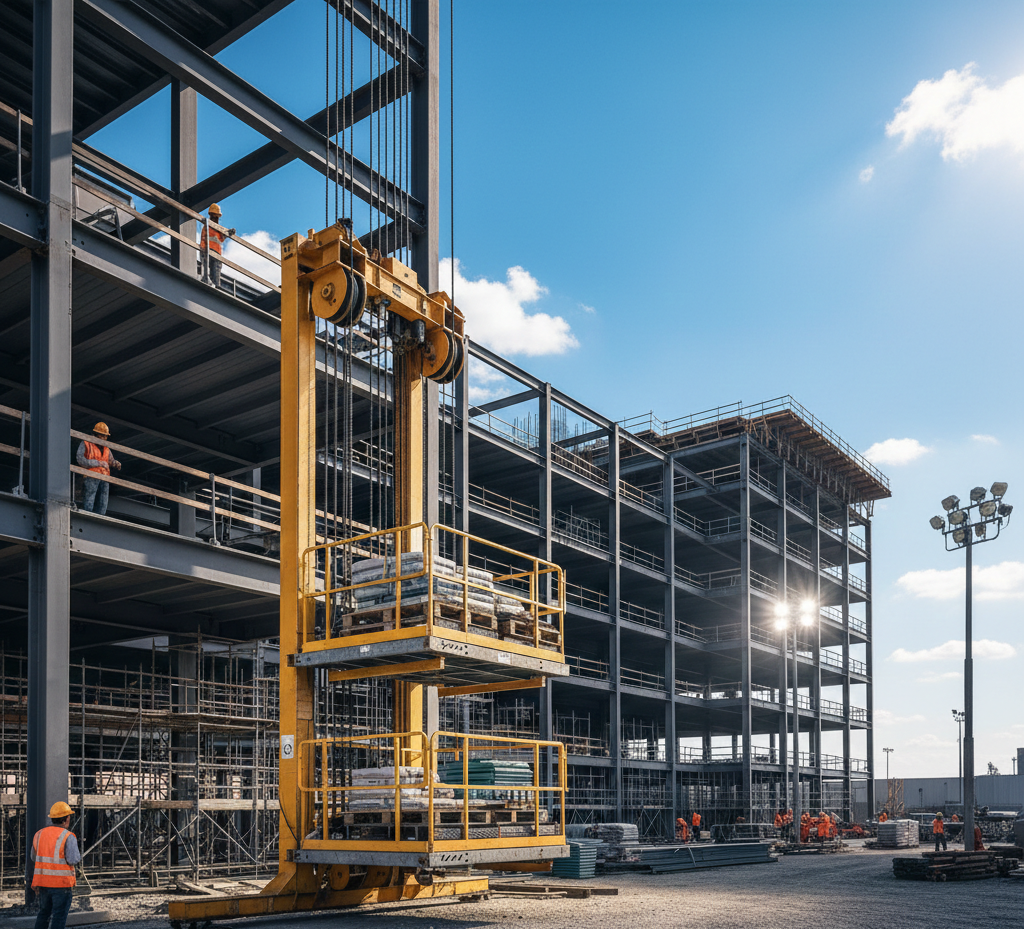
Handling oversized, uneven, or high-weight materials places constant pressure on structures, equipment, and site safety protocols. Load imbalance, sudden shifts, and improper support frequently lead to structural strain, damaged floors, misaligned guide systems, and costly shutdowns. These risks are often underestimated during planning, especially on active construction and industrial sites across Canada and the USA, where vertical material movement is continuous.
At the center of these challenges is the material lift elevator, which must support both weight and load irregularity without transferring stress to surrounding structures. When lifting systems are not engineered for these demands, the consequences extend beyond safety incidents to long-term structural fatigue and equipment failure.
Understanding the Structural Challenges of Heavy and Uneven Material Loads
Heavy materials rarely arrive in uniform shapes. Palletized equipment, fabricated steel, formwork, and mechanical assemblies often have uneven centers of gravity. When lifted improperly, these loads create torsional stress on rails, platforms, and landing zones. Over time, this stress compromises structural alignment and increases wear on mechanical components.
A poorly matched material handling lift amplifies these risks, particularly when load distribution changes between cycles. Structural fatigue becomes a predictable outcome rather than an exception.
How UCEL Material Handling Lifts Are Engineered to Prevent Structural Stress
UCEL Inc. designs lifting systems with structural load management as a primary engineering requirement. Reinforced mast sections, controlled acceleration profiles, and load-rated drive assemblies work together to reduce impact forces during starts, stops, and level transitions.
Each material lift elevator is configured to support consistent vertical travel while minimizing lateral stress transfer to building frames, slabs, and temporary structures.
Stabilizing Irregular Loads with Advanced Lift Carriage and Platform Design
Irregular loads demand more than raw lifting capacity. UCEL platforms incorporate rigid deck construction, reinforced edge supports, and guided carriage alignment to keep loads stable throughout travel. These features reduce sway and prevent uneven force distribution across the lift system.
A well-engineered material elevator ensures that weight remains controlled even when dimensions or balance vary between lifts.
Safety Features That Reduce the Risk of Load Drops
Load drops are rarely caused by a single failure. They result from compounding issues such as uneven loading, sudden shifts, or mechanical overstress. UCEL systems integrate load monitoring, braking redundancy, and controlled descent mechanisms to maintain stability under high-stress conditions.
These safeguards ensure material-handling lift operations remain predictable, even during peak load cycles.
To learn more about how to improve site safety with material lift elevators, read our blog here.
Why Proper Weight Distribution Matters for Structural Integrity
Uneven weight distribution affects more than the lift itself. It transfers stress into anchoring systems, landing gates, and adjacent structures. Over time, this stress accelerates fatigue cracking and alignment issues.
By supporting balanced loading practices and stable lift geometry, a material lift elevator directly helps protect surrounding structural elements.
Operational Best Practices for Safe Heavy and Irregular Load Handling
Engineering alone does not eliminate risk. Safe operation requires consistent load placement, adherence to rated capacities, and regular inspection. UCEL systems are designed to support these practices through clear load indicators and stable operating characteristics.
When paired with disciplined handling procedures, material handling lift systems reduce both immediate hazards and long-term degradation.
Real Applications Where UCEL Material Handling Lifts Deliver Safer Heavy Load Handling
Across construction, infrastructure, and industrial projects in North America, UCEL lifts support the movement of steel assemblies, mechanical equipment, and prefabricated components. These environments demand repeatable performance under variable loading conditions.
In each case, the material elevator functions as a structural safeguard, not just a transport mechanism.
How UCEL Material Handling Lifts Reduce Equipment Damage and Downtime
Structural strain often manifests as misalignment, component wear, and unplanned maintenance. By controlling load behavior and minimizing shock forces, UCEL systems extend service life and reduce downtime caused by corrective repairs.
A properly engineered material lift elevator protects both the lift and the surrounding site infrastructure.
Protect Crew, Equipment, and Structures with UCEL Material Handling Lifts
Structural strain and load drops are preventable when lifting systems are designed for real-world conditions. UCEL Inc. delivers material-handling lift solutions engineered to handle heavy, irregular loads without compromising safety or structural integrity. For projects across Canada and the USA that demand reliability under pressure, UCEL systems provide a proven path to safer vertical material movement.
Connect with UCEL Inc. to select a material elevator engineered for long-term performance and site protection.