
Vertical access equipment is one of the most consequential decisions on a construction site. The choice among a personnel hoist, a material hoist, an industrial elevator, or a building maintenance unit affects the schedule, labor efficiency, and site safety throughout a project. For general contractors, project managers, and site superintendents working on high-rise, industrial, or infrastructure builds, understanding what each type of construction lifting equipment does and where it fits into a project timeline makes procurement decisions considerably easier.
This guide walks through the main categories of construction hoists, lifts, and elevators, how they differ, and what to consider when choosing, renting, or purchasing equipment for a specific project. UCEL Inc. has supplied vertical access equipment for construction projects across Canada and the US for more than 61 years, including 11 of Toronto’s 20 tallest buildings, and the sections below reflect the practical considerations that most often arise when planning a project’s vertical transportation needs.
Vertical access planning tends to get harder, not easier, as a project grows in scale and complexity. A low-rise build might get by with a single hoist and a straightforward mast configuration, while a high-rise tower with multiple trades working simultaneously, tight site boundaries, and an evolving crew size needs a coordinated plan that accounts for capacity, phasing, and safety from the earliest stages of design. For a broader look at how these systems fit together on modern job sites, our post on understanding construction hoists and elevators for modern projects covers the fundamentals in more depth. The goal of this guide is to give project teams a clearer starting point for that planning process, whether the immediate question is which hoist type fits a specific building or a broader decision about renting versus owning equipment across multiple projects.
What should you consider before choosing a construction lift?
Construction hoists, industrial elevators, and building maintenance units each serve different purposes. Choosing the right equipment depends on the project stage, lifting requirements, and long-term operational needs.
Key Takeaway: Match the equipment to the job, use certified systems with trained operators, and choose renting or purchasing based on how often the equipment will be used.
Types of Construction Lifts and Their Applications
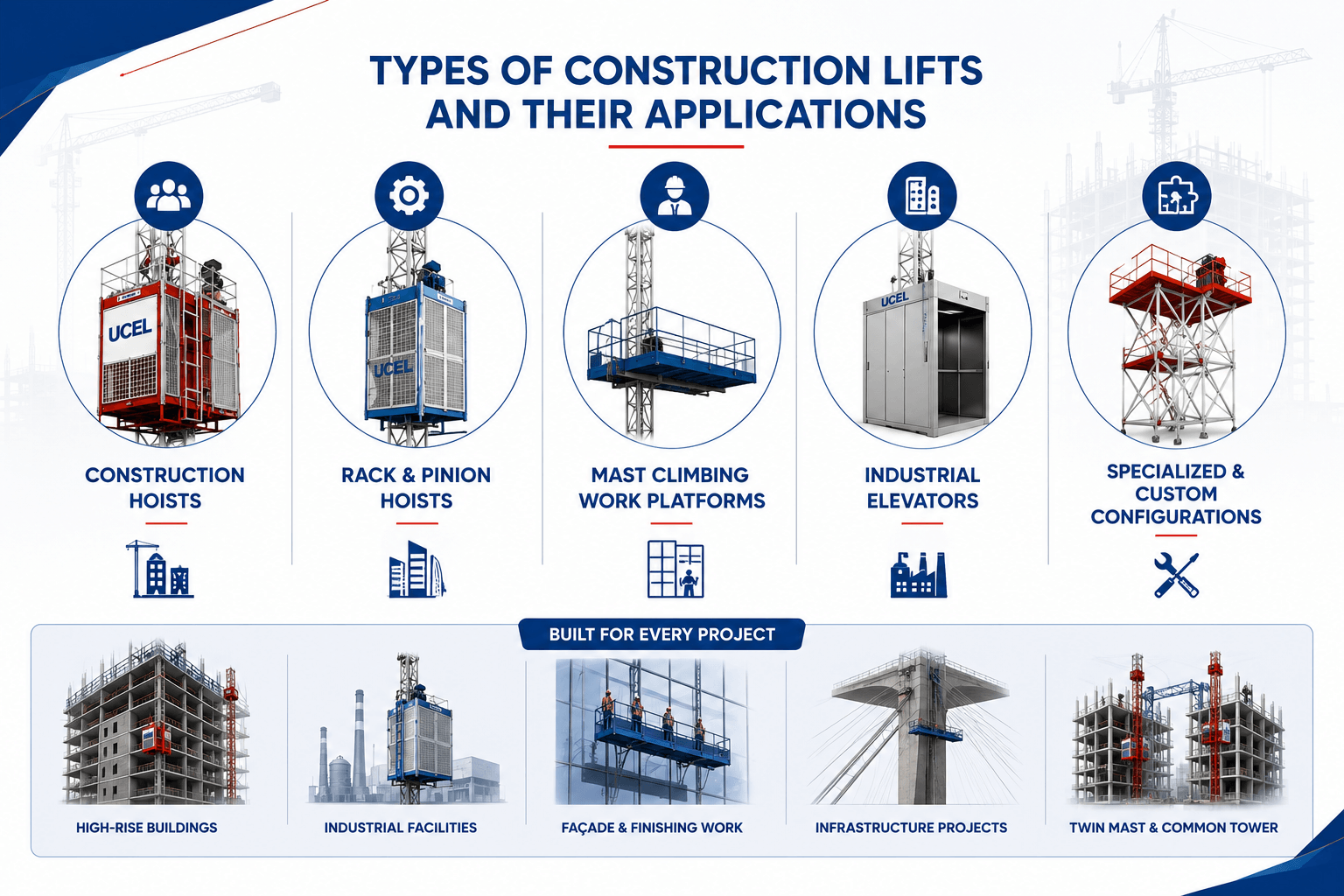
Construction sites typically rely on multiple types of vertical access equipment, since different phases of a project require varying lifting capacities, speeds, and configurations. Broadly, construction hoists move workers and materials during the active construction phase. At the same time, industrial elevators tend to serve longer-term or more specialized vertical transportation needs, including some permanent installations in industrial facilities.
Rack and Pinion Hoists
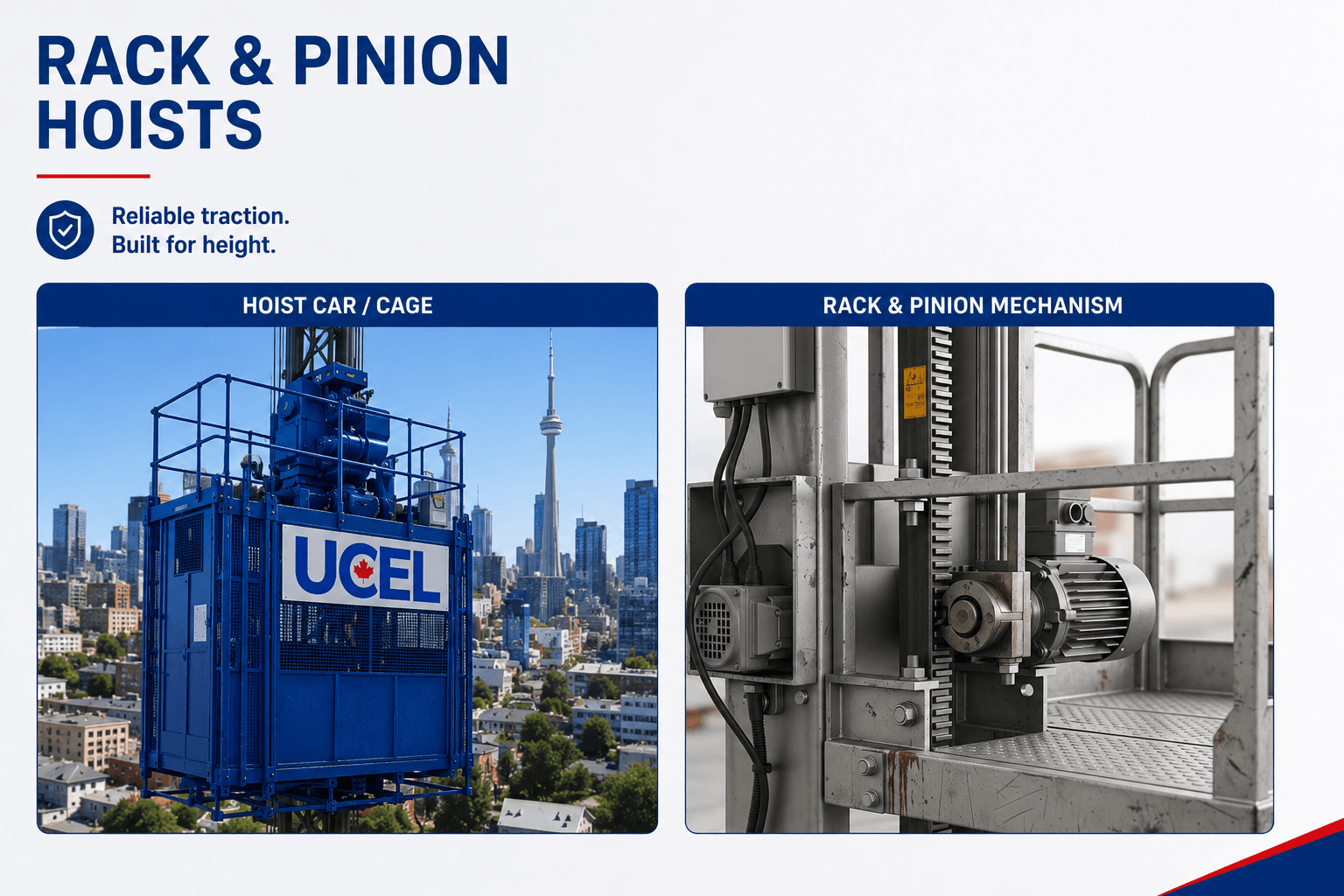
Rack-and-pinion hoists use a toothed rail mounted to the mast and a matching pinion gear on the cage, providing consistent traction regardless of load or weather conditions. This makes them a common choice for high-rise construction where reliability at height is a priority.
Mast Climbing Work Platforms
Mast climbers provide a working platform that travels vertically along a mast and are often used for façade work, cladding, and finishing trades that require a stable, adjustable platform rather than a passenger cage. They complement hoists rather than replacing them, since crews often need both a way to move materials and a platform to work from at height.
Specialized and Custom Configurations
Some projects require equipment configured for unusual site constraints, including twin-mast setups, common towers shared between adjacent structures, or setback towers designed for buildings with stepped façades. Matching the equipment type to the site layout early in planning avoids costly reconfiguration later in the project.
These custom configurations are rarely an afterthought on complex builds. A tower with a stepped or tapering profile, for example, may need its hoist mast relocated or reconfigured partway through construction to stay aligned with the building’s changing footprint, which is far easier to plan for at the outset than to retrofit once the structure is already partially built. Site teams that involve their equipment supplier during early design coordination, rather than after the foundation is poured, tend to avoid the most disruptive and expensive changes later on.
Every project’s vertical access needs are different. Contact UCEL Inc.’s team to discuss which equipment combination best fits your site plan.
Complete Guide to Construction Hoists
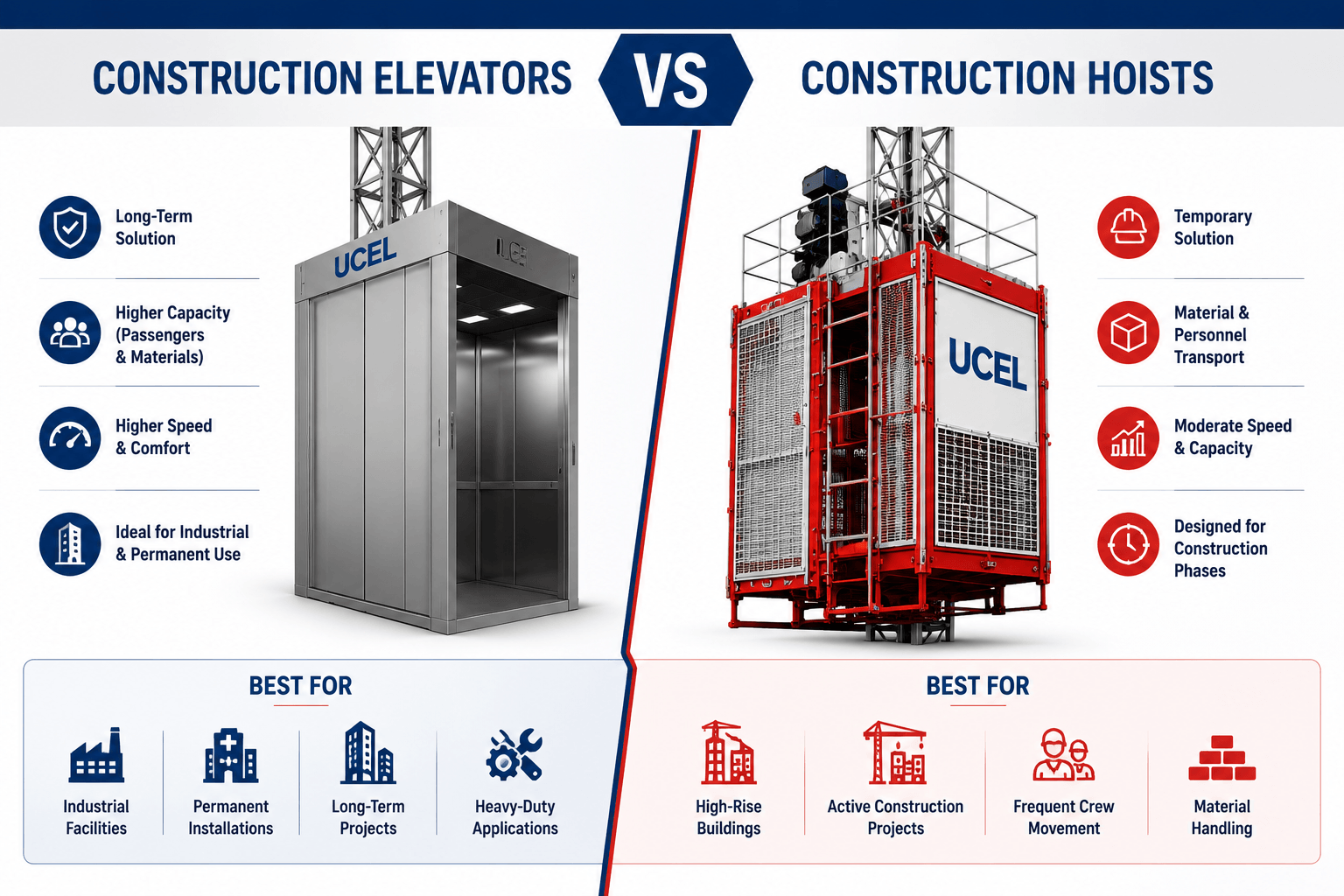
A construction hoist is a temporary, motorized platform that runs along an external mast attached to a building under construction, transporting workers, tools, and materials between ground level and upper floors. Unlike a permanent elevator, a construction hoist is designed to be installed, extended as the building rises, and eventually removed once the structure no longer requires it.
Core Components of a Construction Hoist
A typical hoist system consists of a mast, a motorized cage or platform, landing gates at each floor, and a control system that manages speed, load limits, and safety interlocks. The mast is extended in sections as the building grows taller, so the hoist needs to be specified with the project’s final height in mind from the outset, not just for its current phase.
Landing gates deserve particular attention in this list, since they are the point where the hoist interacts most directly with pedestrian traffic and material staging on each floor. Poorly positioned or undersized landing gates can create bottlenecks that slow down the entire hoist cycle, regardless of how capable the mast and cage system itself is. Coordinating landing gate placement with the site’s material staging plan, rather than treating it as a fixed default location, often improves throughput more than upgrading the hoist’s motor or cage capacity would.
Transport Platforms and Load Configurations
Many construction hoists are supplied as combined personnel-and-material transport platforms, allowing a single piece of equipment to handle both worker transport and material delivery across shifts. This flexibility is particularly valuable on sites where floor space for multiple pieces of equipment is limited, or where the project schedule shifts between phases that prioritize crew movement and phases that prioritize material delivery.
Capacity Planning Across Project Phases
Hoist capacity needs typically change as a project progresses, with early phases favoring higher material throughput and later phases favoring personnel movement as trades multiply on site. Planning for this shift in advance, rather than reacting to it, helps avoid bottlenecks during the busiest stages of a build.
Reach out to UCEL Inc. to size a construction hoist system around your building’s height, phasing, and crew requirements.
Construction Elevators vs Construction Hoists
The terms “construction elevator” and “construction hoist” are sometimes used interchangeably, but there are meaningful differences worth understanding before specifying equipment for a project.
How Construction Elevators Differ
Construction elevators, including temporary and special purpose elevators, are often used in applications that extend beyond the typical construction hoist timeline, such as long-duration industrial projects, facilities that need continued vertical access after the main build is complete, or sites with unusual load and speed requirements. These systems are frequently engineered closer to permanent elevator standards, even when installed temporarily. Our article on how sourcing construction hoist elevators impacts high-rise project timelines in Ontario looks at how this decision plays out on real high-rise schedules.
When a Hoist Is the Better Fit
For most standard construction projects, a hoist remains the more practical choice since it is designed specifically for the install-extend-remove cycle of an active build and is typically faster to mobilize and demobilize than a more elevator-style system. The decision often comes down to project duration, load profile, and whether the equipment must meet stricter performance standards than those of a standard construction hoist.
Matching Equipment to Project Duration
Short-duration projects rarely justify the added engineering complexity of an elevator-style system, while multi-year builds or facilities with ongoing vertical access needs after substantial completion often do. Reviewing the expected project timeline honestly during the planning stage prevents both over-specifying and under-specifying equipment.
It also helps to consider what happens at the end of a project, not just during active construction. A facility that will need continued vertical access for maintenance, inspection, or operational staff once the build is substantially complete may be better served by transitioning toward permanent or semi-permanent elevator infrastructure rather than removing a construction hoist entirely and installing something new later. Planning this transition as part of the original equipment strategy, instead of as a separate future project, tends to be more cost-effective overall.
Not sure whether your project calls for a hoist or a full elevator system? UCEL Inc.’s team can help you compare both options against your project timeline.
Personnel Hoists vs Material Hoists
Within the construction hoist category itself, the distinction between personnel and material hoists shapes many of the design and safety requirements that follow.
What Sets Personnel Hoists Apart
Personnel hoists are engineered specifically for transporting workers, which means they carry additional safety features such as enclosed cages, emergency stop systems, and stricter load and speed governance compared to equipment designed only for materials. Because personnel hoists move the largest number of people on a site during shift changes, their reliability and throughput directly affect how efficiently a workforce can start and end each day. Our post on how the best personnel hoist solutions across the USA accelerate high-rise timelines looks at this impact in more detail.
The Role of Dedicated Material Hoists
Material hoists are built to move heavier or bulkier loads, such as pallets of building materials, equipment, and tools, without the passenger safety systems required for personnel transport. Keeping material movement separate from personnel movement, where site space allows, reduces congestion at landing points and keeps crew transport schedules more predictable. As explained in why material hoists are essential for high-rise construction in Ontario, this separation becomes especially important as building height and material volumes increase.
Combined Systems for Smaller Sites
On sites where space or budget does not support separate systems, combined personnel and material hoists offer a practical middle ground, provided the equipment is rated and configured to handle both duties safely. This is often where a transport platform configuration becomes useful, since it can flex between passenger and material use depending on the shift.
Scheduling becomes the main consideration once a site moves to a combined system, since personnel and material movements now compete for the same equipment. Many project teams address this by setting fixed windows for material handling outside peak shift-change hours, keeping the busiest periods for personnel movement free of large material loads. This kind of scheduling discipline often does more to keep a combined hoist system running smoothly than any single piece of hardware could.
Talk to UCEL Inc. about whether your site is better served by dedicated or combined hoist systems.
Rack and Pinion Hoists Explained
Rack-and-pinion technology underlies much of the construction hoist and elevator equipment used on modern high-rise projects, and understanding how it works helps explain why it has become the industry standard.
How the Mechanism Works
A rack-and-pinion system uses a toothed rail, the rack, fixed vertically along the mast, paired with a rotating gear, the pinion, mounted on the hoist cage. As the pinion turns, it climbs the rack, providing positive mechanical engagement rather than relying on friction between a cable and drum. This design provides rack-and-pinion systems with consistent performance in wet, icy, or windy conditions, where friction-based systems can lose traction.
Advantages for Tall and Complex Builds
Because the mast can be extended in sections as a building rises, rack and pinion elevators scale naturally with project height, without the length limitations that cable-based systems face at extreme elevations. This makes them well-suited to high-rise construction, where the hoist must continue to function reliably as the building grows from a few stories to its full height.
Maintenance Considerations
Rack and pinion systems require regular inspection of the gear teeth, mast alignment, and safety brake mechanisms, as these components bear the system’s full mechanical load. Partnering with a supplier who understands the maintenance schedule for this equipment type helps keep a hoist in service throughout a long build rather than facing unplanned downtime during a critical phase.
Weather and site conditions play a larger role in maintenance planning than many teams expect. Dust and debris accumulation on the rack, temperature swings that affect lubrication, and exposure to rain or snow on an exterior mast all influence how often inspection and servicing should occur. A maintenance schedule built around the specific climate and site conditions of a project, rather than a generic manufacturer default, tends to catch wear issues before they affect hoist reliability.
If your project calls for rack-and-pinion equipment, UCEL Inc. can help you specify and maintain a system suited to your building’s height and phasing.
Industrial Elevators for Construction Projects
Beyond standard construction hoists, many projects in industrial, energy, and infrastructure sectors require elevator systems engineered for more specialized or longer-term use.
Explosion-Proof and Special Environment Elevators
Certain industrial environments, including oil and gas facilities and chemical processing plants, require explosion- and flameproof-rated equipment to operate safely in areas with combustible gases or dust. Specifying equipment rated for these conditions from the outset avoids costly retrofits and keeps a facility compliant with the safety standards specific to its industry. Our comparison of explosion proof hoists and flameproof elevators for Alberta mining operations breaks down how to evaluate this equipment for hazardous environments.
Building Maintenance Units (BMUs): Purpose and Benefits
Once a building is complete, the vertical access challenge shifts from construction logistics to long-term façade maintenance, which is where building maintenance units come in.
What a BMU Does
A building maintenance unit, or BMU, is a permanently installed system, typically mounted on the roof, that positions a platform or cradle along the exterior of a building to support window cleaning, façade inspection, and maintenance work. Unlike temporary construction hoists, a BMU is designed to remain in service for the building’s operational life.
Why BMUs Matter for High-Rise and Complex Façades
Buildings with unusual geometry, curtain wall systems, or significant height present maintenance challenges that cannot be safely or efficiently addressed with swing stages or rope access alone. A properly engineered BMU accounts for the building’s specific façade profile, wind loading, and access points, giving facility managers a reliable, code-compliant way to maintain the exterior for decades after construction ends.
Ongoing Service and Support
Because a BMU operates for the life of the building, ongoing inspection and maintenance matter as much as the initial installation. UCEL Inc.’s BMU service contracts are designed to keep these systems operating safely and reliably long after the construction crew has moved on to the next project.
A BMU that falls out of service, even temporarily, can quickly create a backlog of deferred façade maintenance, since alternative access methods for tall or complex buildings are often slower and more expensive to mobilize. Facility managers who schedule preventive inspections on a fixed calendar, rather than waiting for a fault to appear, tend to avoid the longer outages that come with reactive repairs on equipment exposed to the elements year-round.
If your building’s design includes complex façade elements, UCEL Inc. can help plan a BMU system during the design phase rather than after occupancy.
How to Choose the Right Vertical Access Equipment
With so many hoist, elevator, and platform options available, narrowing down the right construction lifting equipment for a specific project comes down to a handful of practical questions.
Assessing Project Scale and Duration
Building height, project duration, and the number of trades expected on site at peak activity all influence whether a standard hoist, a combined transport platform, or a more specialized elevator system makes sense. Underestimating peak crew size is one of the more common planning mistakes, since it often leads to congestion at hoist landings during the busiest weeks of a project.
Matching Equipment to Site Constraints
Site footprint, proximity to neighboring structures, and façade design all affect where a hoist or elevator mast can be positioned and how it needs to be configured. Projects with limited ground space sometimes benefit from shared towers between adjacent buildings, while others require custom setback tower configurations to accommodate a stepped or angled façade.
Working With an Experienced Supplier
UCEL Inc.’s team includes engineers, electricians, and mechanics who can help translate a project’s specific requirements into an equipment specification, rather than starting with a generic catalog configuration. Reviewing the full product range early in project planning also helps identify accessories, such as landing gates, enclosures, and intercom systems, that need to be included in the overall vertical access plan.
Not sure where to start? UCEL Inc.’s team can walk through your project’s scale, site constraints, and timeline to recommend the right equipment mix.
Construction Hoist Safety Standards and Best Practices
Safety governs nearly every aspect of construction hoist design, installation, and operation, and understanding the applicable standards helps site teams evaluate whether equipment and procedures meet the bar set by their jurisdiction.
Certification and Manufacturing Standards
Equipment manufactured to ANSI, TUV, and CSA standards and built in ISO9001-certified facilities gives project teams confidence that a hoist or elevator has been engineered and tested against recognized safety benchmarks rather than a manufacturer’s internal criteria alone. Verifying these certifications during procurement is a straightforward way to rule out equipment that does not meet the standards required on a given project.
Operator Training and Site Procedures
Even well-engineered equipment depends on trained operators and disciplined site procedures to operate safely. Load limits, pre-shift inspections, and clear communication protocols between hoist operators and site supervisors all reduce the risk of incidents, particularly during the highest-traffic periods of a project such as shift changes or major material deliveries. Our article on safety checks for explosion-proof hoists in Ontario chemical plants illustrates how disciplined inspection routines translate into measurable on-site risk reduction.
Documentation plays a bigger role in this process than it is often given credit for. Logging pre-shift inspections, recording any anomalies noticed during operation, and keeping a clear maintenance history make it far easier to spot developing issues before they become safety incidents. This kind of record-keeping also supports compliance during site audits. It gives a clear trail of accountability if a piece of equipment ever needs to be reviewed after an incident.
Ongoing Inspection and Maintenance
Regular inspection of mast alignment, safety brakes, control systems, and landing gates keeps a hoist performing as designed throughout a project’s duration. UCEL Inc.’s training centre supports both operator training and the technical knowledge needed to keep equipment compliant and reliable from mobilization through to final demobilization.
Prioritizing certified equipment and proper training protects your crew and your schedule. Contact UCEL Inc. to review your site’s safety requirements.
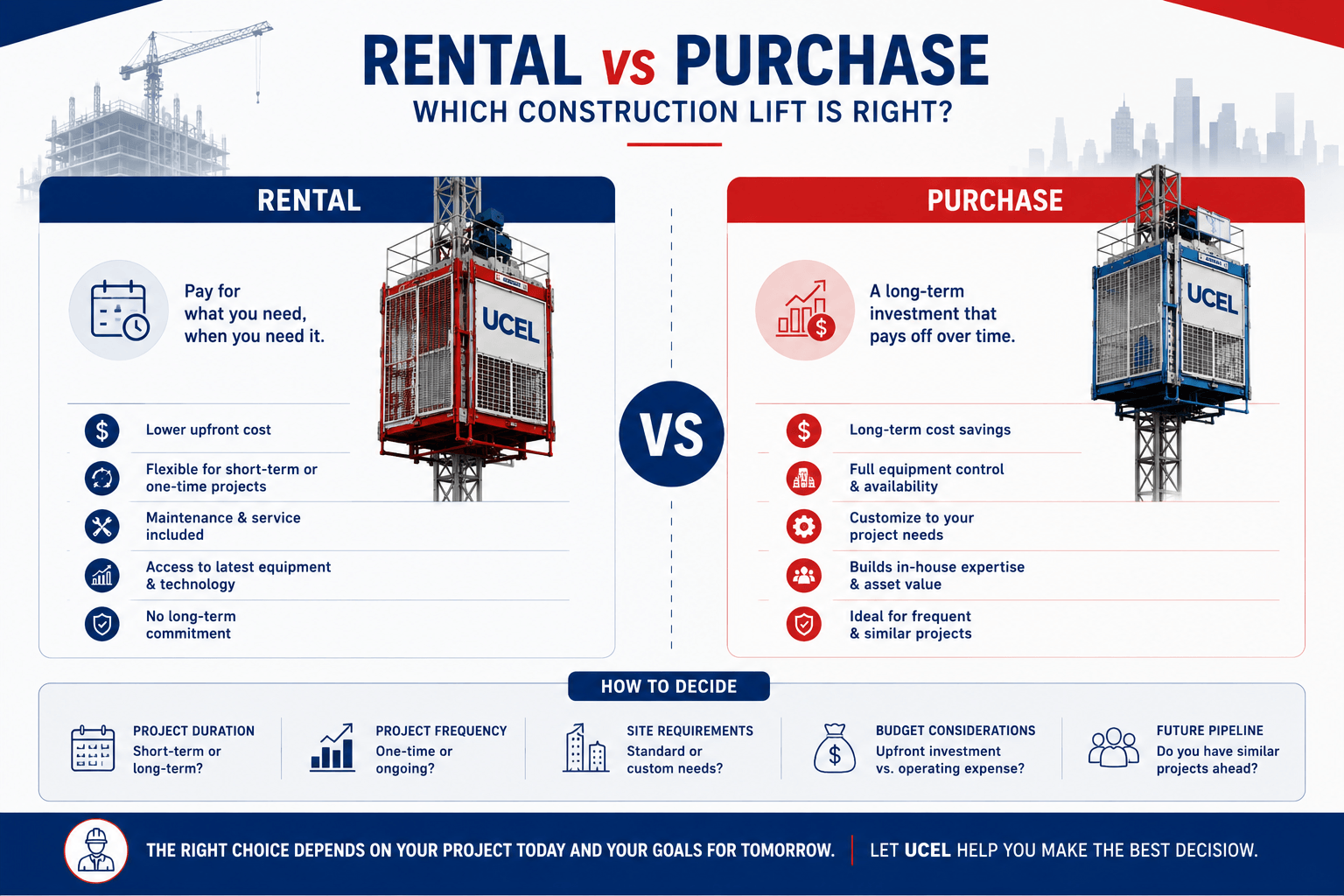
Rental vs Purchase: Which Construction Lift is Right?
The decision between renting and purchasing vertical access equipment depends heavily on project duration, company growth plans, and how often a business takes on projects that require this equipment.
When Renting Makes Sense
For single projects, shorter builds, or companies taking on an unfamiliar project type, rental offers flexibility without the long-term commitment of ownership. Renting also shifts much of the maintenance and lifecycle planning burden to the supplier, which can simplify budgeting for contractors managing multiple projects at once.
When Purchasing Makes Sense
Companies with a steady pipeline of projects requiring similar equipment often find that purchasing reduces long-term costs compared to repeated rental fees, while also giving them full control over scheduling and availability rather than competing for rental inventory during busy seasons. Ownership makes the most sense when a business can reliably keep the equipment in consistent use across projects.
Factors That Influence the Decision
Project frequency, capital availability, storage and transport logistics, and in-house maintenance capability all factor into whether rental or ownership is the more practical path. Many contractors use a mixed approach, owning core equipment for most projects while renting specialized units for less frequent or highly project-specific needs.
It is also worth factoring in how quickly a rental fleet can respond to changing project timelines. Construction schedules often shift, and a rental partner with strong equipment availability and fast mobilization can absorb some of that uncertainty in ways ownership cannot always match, particularly for contractors managing several projects with overlapping yet unpredictable timelines. Weighing this flexibility alongside the pure cost comparison between renting and buying provides a more complete picture of which approach best serves a project.
UCEL Inc.’s rental and sales teams can walk through the numbers for your specific project pipeline to help determine which approach fits best. Contact UCEL Inc. to discuss your vertical access equipment needs today.
Frequently Asked Questions
Do I need separate hoists for workers and materials?
Not always. Combined personnel and material hoists work well on smaller sites, but dedicated hoists reduce congestion and improve scheduling on larger, busier projects.
What safety standards should construction lifting equipment meet?
Look for equipment manufactured in ISO9001 facilities and certified to ANSI, TUV, or CSA standards, depending on your project's location and requirements.
Is it better to rent or buy vertical access equipment?
Renting suits single or short-term projects, while purchasing is more cost-effective for contractors with a steady pipeline of similar work.
What is a building maintenance unit (BMU) used for?
A BMU is a permanent rooftop-mounted system installed after construction to support ongoing window cleaning, façade inspection, and exterior maintenance.