When a
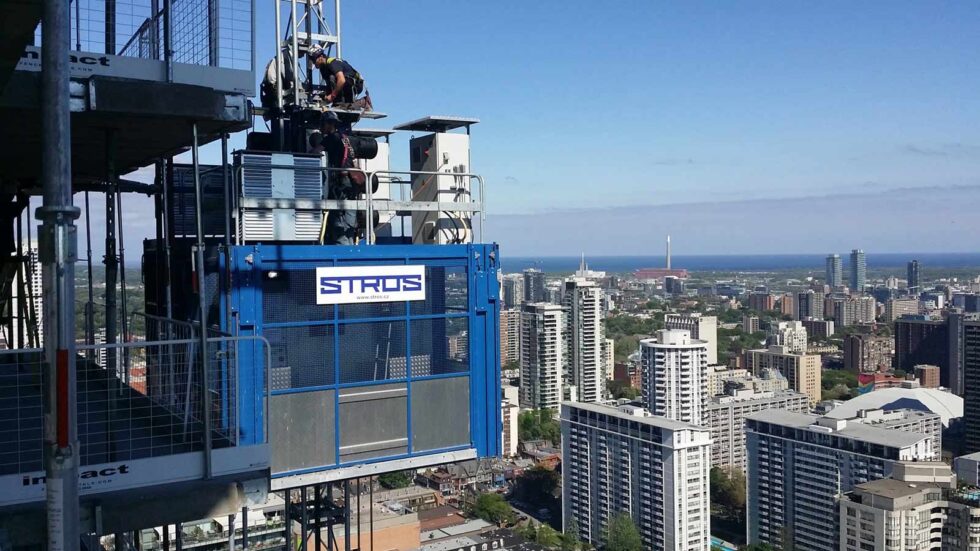
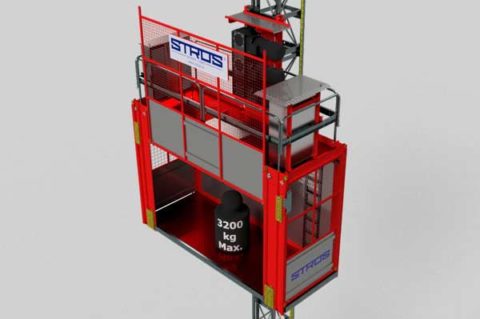
construction hoist or industrial elevator stops unexpectedly, workers lose access to active floors, materials miss planned delivery windows, trades need rescheduling, and recovery work adds even more cost. Downtime on industrial elevators and lifts costs more than the repair itself, every time.
That’s why project teams should weigh reliability right alongside rental or purchase price, not after it. Equipment condition, preventive maintenance, monitoring, parts availability, technical support, and service response all shape the real cost of keeping industrial elevator lift systems running, whether that’s an industrial service elevator handling daily plant traffic or custom industrial elevators built for a specific facility. Get any one of those wrong and the price on the quote stops mattering fast.
Industrial buildings’ elevators carry that same weight. A facility running continuous operations can’t treat vertical access as a line item it checks once and forgets.
UCEL Inc. has supplied industrial elevators and lifts across Canada and the Northeastern United States since 1963, backed by in-house maintenance, parts availability, and technician response built around exactly this kind of downtime risk.
Equipment Price Is Only One Part of the Cost
A lower rental rate can look attractive during procurement. It becomes less attractive when the equipment supporting daily movement cannot perform when the project needs it.
Vertical transportation sits directly inside the workflow of a high-rise project. Workers need to reach active floors. Materials need to arrive before installation. Multiple trades often depend on the same access route. Research into high-rise construction logistics has consistently identified vertical transportation planning as an important factor in labour productivity and schedule performance.
The same principle applies to permanent industrial elevators. A facility may depend on an elevator to move maintenance crews, tools, components or materials between operating levels. When that access disappears, the cost depends on what the elevator was supporting at the time.
That changes the purchasing question.
Instead of asking only, “What does the equipment cost?”, project teams should also ask, “What will it cost us if this equipment is unavailable when we need it?”
What Downtime Costs on a High Rise or Industrial Site
There is no universal hourly downtime figure. Every project has a different crew size, schedule, access plan, and contractual structure.
A better approach is to calculate the exposed areas.
True downtime cost can include:
- Idle labour waiting for access
- Reduced material movement
- Lost productive work time on upper floors
- Trade resequencing
- Additional supervision and coordination
- Overtime used to recover the schedule
- Extended equipment rentals
- Delayed milestone completion
- Additional repair or replacement costs
- Contractual exposure where delay provisions apply
- Restart inspections or testing where required
These costs also interact.
A mechanical crew waiting at ground level is one cost. The electrical crew that cannot start because the mechanical work is unfinished creates another. A material delivery that then needs to be moved to another day can create additional coordination.
This is why the direct repair invoice rarely shows the complete economic impact.
Where Vertical Access Downtime Creates Cost
| Cost Area |
What Happens During Downtime |
Project Impact |
| Labour |
Crews wait, change tasks, or lose productive hours |
Higher labour cost per completed task |
| Material movement |
Deliveries cannot reach planned floors or work areas |
Installation work falls behind schedule |
| Trade sequencing |
One delayed crew holds up work scheduled after it |
Multiple trades face schedule disruption |
| Overtime |
Teams work additional hours to recover lost production |
Labour costs increase |
| Equipment rental |
Project delays extend rental periods |
Additional rental expense |
| Supervision |
Site leaders spend time reorganizing crews and deliveries |
Less time focused on planned production |
| Maintenance access |
Industrial staff lose access to required levels |
Repairs or facility work take longer |
| Contract milestones |
Delays affect scheduled completion dates |
Possible contractual and financial exposure |
Not every outage creates all of these costs. The exposure depends on how many people and activities rely on the equipment. A main construction hoist serving several active floors carries a different risk than an elevator with another practical access route.
For industrial elevators and lifts, the calculation may be different. Downtime in a power facility, processing plant, warehouse or other industrial environment can affect maintenance access and internal material movement. The level of financial exposure depends on how critical the elevator is to the operating process.
Learn how inefficient vertical transportation affects labour movement and trade coordination in its guide on
reducing labour downtime with personnel hoists.
What Can One Day of Hoist Failure Trigger?
Picture a high-rise site at 7:00 a.m. The main hoist serves active work above level 20. Several trades arrive with labour and materials already sequenced for the morning.
The hoist stops.
At 7:15, workers begin waiting at grade. A supervisor redirects one crew to prep work. Another crew has nothing useful to start. Materials for upper floors stay in the staging area.
By mid-morning, the original plan has changed. Deliveries need new time slots. Work scheduled after the affected trade starts slipping. Supervisors spend time coordinating around the outage instead of managing production.
Service restores the hoist later in the day. The backlog does not disappear. Workers, tools, and materials from the missed period now compete with normal afternoon traffic.
This is what rate comparisons miss. One equipment fault creates several smaller costs, each owned by a different part of the project.
The useful takeaway is practical. A hoist supports more than transportation. It supports sequence.
Why Maintenance Changes the Downtime Equation
Preventive maintenance gives technicians an opportunity to identify wear, alignment concerns, braking issues, electrical problems and other conditions before they develop into larger faults.
It also allows service activity to be planned around the operating schedule rather than forcing the schedule to react to an unexpected breakdown.
For permanent
industrial elevator lift systems, maintenance planning should consider the equipment design, duty cycle, environment and frequency of use. A lightly used
industrial service elevator does not necessarily require the same service plan as equipment operating frequently in a demanding process facility.
UCEL Inc. provides maintenance programs for traction, hydraulic, and rack-and-pinion permanent elevators. Its service approach includes
lifecycle maintenance planning intended to reduce unplanned failures and minimize interruptions to normal operations.
The important procurement lesson is simple. Maintenance is not only a service expense. It is part of risk control.
For rental construction equipment, condition before arrival matters as well. UCEL Inc. rental units pass through its in-house refurbishment centre after projects and are tested using its in-house test tower. Scheduled OEM maintenance is then performed on site. Project teams comparing service plans should also review how they approach preventive maintenance for temporary equipment and permanent industrial elevators.
Does Certification Guarantee Reliability?
No,
certification and compliance are essential safety considerations, but they should not be treated as guarantees that equipment will never stop.
Equipment can satisfy applicable requirements and still develop wear or faults during service. Installation quality, operating conditions, loading, maintenance and component condition also matter.
For project teams, the stronger reliability question is:
Is the equipment appropriately certified, properly installed, routinely maintained and supported by a service organization capable of responding when something changes?
Skipping scheduled maintenance because the equipment is currently working can create unnecessary exposure later. A small developing issue is easier to address during planned service than after it has interrupted an active shift.
How Real-Time Monitoring Can Catch Problems Earlier
Monitoring systems can provide information on usage, operating duration, load conditions and maintenance requirements. Research into elevator maintenance has also shown how connected monitoring can support a move from purely reactive maintenance toward condition-based approaches.
For construction teams, the practical value is visibility.
Real-time information can help identify unusual operating patterns, track utilization and flag conditions that deserve attention before they become larger problems.
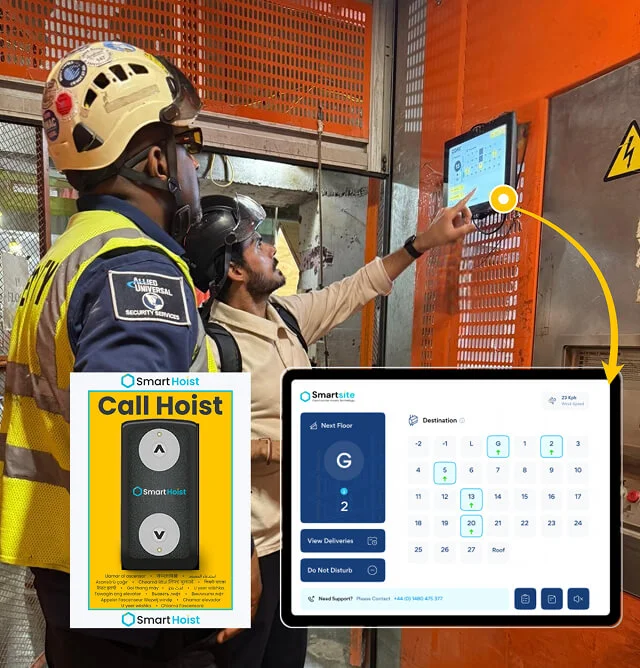
UCEL Inc. offers remote monitoring on its construction hoists and industrial access equipment. Its own smart technology guidance also identifies operating data and maintenance scheduling as uses for connected hoist systems.
Monitoring does not replace physical inspection or preventive maintenance.
Its value is that maintenance teams have another source of information when deciding when equipment needs attention.
Why Service Response Time Should Be Part of Procurement
A reliable machine can still experience an unexpected fault.
At that point, equipment specifications matter less than what happens next.
- How quickly can the provider identify the problem?
- Is a qualified technician available locally?
- Does the technician understand the equipment?
- Are common replacement parts already stocked?
- If a part is not available, how long will sourcing take?
These questions are rarely given the same attention as capacity, speed or rental price. They can become far more important once equipment stops.
When evaluating a construction hoist provider or support for
industrial elevators and lifts, ask:
- Where are service technicians located?
- What support is available outside normal working hours?
- Are technicians trained for the equipment being supplied?
- Which common replacement components are kept locally?
- How are urgent service calls prioritized?
- Is maintenance history documented?
- What testing is completed before rental equipment returns to service?
- Who coordinates any required inspection before operation resumes?
UCEL Inc. has more than 40 technicians supporting its service operations. It also maintains a Toronto parts inventory that can supply the majority of construction hoist parts by the next day.
Those capabilities matter because repair time consists of more than technician labour. Diagnosis, travel, parts sourcing, repair, testing, and return to service all contribute to the duration of an interruption.
Reliability Starts With Equipment Selection
Maintenance cannot fully correct an equipment selection problem.
An undersized hoist can create queues even when it is functioning correctly. Equipment that is poorly matched to the environment may experience unnecessary stress. A system that lacks the required capacity can constrain daily movement.
For
custom industrial elevators, reliability planning should begin with the operating requirements.
Project teams should define:
- Required load capacity
- Travel height
- Expected trip frequency
- Personnel and material requirements
- Environmental exposure
- Temperature and weather conditions
- Available electrical supply
- Access for future maintenance
- Required safety standards
- Parts and service availability
- Expected operating life
- Criticality of the elevator to site operations
The last point is particularly important.
If an industrial service elevator is the only practical access route to a critical maintenance area, its reliability value is much higher than that of equipment with a readily available alternative.
The design and support strategy should reflect that dependency.
Should a Project Plan Redundancy for Vertical Access?
Sometimes the answer is yes.
Redundancy does not always mean installing two identical elevators. The right approach depends on project risk.
A high-rise project may use multiple hoist cars or plan separate routes for people and materials. An industrial facility may have alternative access for maintenance crews. Another facility may determine that the cost of redundant equipment is justified because loss of the primary elevator creates unacceptable operational disruption.
The decision should be based on consequence.
Ask what happens when the primary access system becomes unavailable for an hour, a shift or longer. If the answer involves widespread idle labour or loss of essential access, the contingency plan deserves more attention.
This is another reason
industrial elevator lift systems should be designed around operational requirements rather than selected from a standard equipment list.
A Reliability First Equipment Strategy
A strong
vertical access plan connects equipment selection, maintenance and service before mobilization or installation.
Use the following framework:
1. Map the dependency
Identify which workers, materials, trades or facility functions depend on the elevator.
2. Estimate the consequence of downtime
Look beyond repair costs. Include labour, sequencing, recovery and operational impact.
3. Select for actual duty
Capacity, travel, operating frequency and environmental conditions should reflect real usage.
4. Review equipment condition
For rental equipment, understand refurbishment, testing and maintenance practices.
5. Confirm preventive maintenance
Know what maintenance is included, how often it occurs and who performs it.
6. Review monitoring capabilities
Determine what operational information is available and how alerts are handled.
7. Assess service support
Technician availability, local coverage and parts inventory should be evaluated before a breakdown occurs.
8. Plan the contingency
Define what workers and supervisors should do if the primary system becomes unavailable.
This approach turns reliability into a measurable project consideration instead of a vague supplier promise.
What Should Teams Look for When Comparing Industrial Buildings Elevators?
Teams researching
industrial building elevators should start with operational dependency rather than appearance or standard passenger elevator specifications.
Industrial environments can require different capacities, controls, materials, access arrangements and maintenance strategies. Exposure to dust, weather, moisture or demanding operating conditions can also influence equipment design.
That is why custom industrial elevators can make sense when a standard configuration does not match the building or process requirement.
UCEL Inc. supplies
customized industrial elevator solutions and provides service and maintenance support for traction, hydraulic and
rack and pinion equipment. Its vertical access experience dates to 1963.
Final Thoughts: Treat Downtime as a Line Item Before It Happens
A construction hoist or industrial elevator should not be evaluated only by what it costs while it is running.
The bigger financial question is what happens when it is not.
Reliable equipment, planned maintenance, useful operating data, available parts and responsive technical support help reduce the number of variables a project team has to manage when schedules are already under pressure.
When vertical access supports critical labour, materials or maintenance activity, downtime risk belongs in the original equipment decision. Waiting until the system stops is usually the most expensive time to start thinking about reliability.
UCEL Inc. supports construction hoists, industrial elevators, BMUs, rental and sales services, custom design, installation support and ongoing maintenance across its vertical access offering. That gives project and facility teams an opportunity to consider reliability from equipment selection through long-term service.
Frequently Asked Questions
How does vertical access downtime affect a construction project?
Downtime can delay worker movement, material delivery and trade sequencing. The wider cost may include idle labour, overtime, schedule recovery and extended equipment use.
Is cheaper rental equipment always more economical?
No. Rental price is only one cost. Equipment condition, maintenance, reliability, technician response and parts availability can have a greater financial impact if downtime occurs.
Can preventive maintenance eliminate elevator downtime?
No maintenance program can guarantee zero downtime. Preventive maintenance can reduce risk by identifying developing issues before they become larger failures and by moving more service work into planned periods.
What role does monitoring play in industrial elevators?
Monitoring can provide operating information that helps service teams identify unusual conditions and plan maintenance earlier. It supports maintenance decisions but does not replace physical inspection or required testing.
What should be included in the lifecycle cost of an industrial elevator?
Consider equipment and installation cost, scheduled maintenance, parts, service access, energy use, expected operating life, downtime exposure and the operational consequence of losing vertical access.