
When you choose the wrong hoist for building construction, it does not slow down just one process. It slows down every trade that depends on getting people and materials up and down the building. This is due to a wrong choice of hoist construction equipment in the first place.
A hoist that cannot keep pace with your schedule turns a manageable delay into a schedule crisis. So does a unit that is not rated for your local jurisdiction, or a supplier who cannot get a technician to site within hours.
UCEL Inc. has supplied hoists for building construction and industrial elevator solutions since 1963. The patterns in this guide come from six decades of watching projects succeed or struggle based on how early, and how carefully, vertical access got planned.
This page breaks down what vertical access actually covers, the factors that should drive your hoist construction equipment decisions, the certification landscape across Canada and the Northeastern United States, and how to evaluate a supplier before you sign a contract.
What Vertical Access Covers on a Modern Job Site
Vertical access is a category, not a single product. It’s the full set of systems that move people, materials, and equipment up and down a structure, from the first weeks of excavation through years of ongoing building maintenance. Most projects need more than one type of equipment, and those systems have to work together. That’s the part people miss.
Construction Hoists
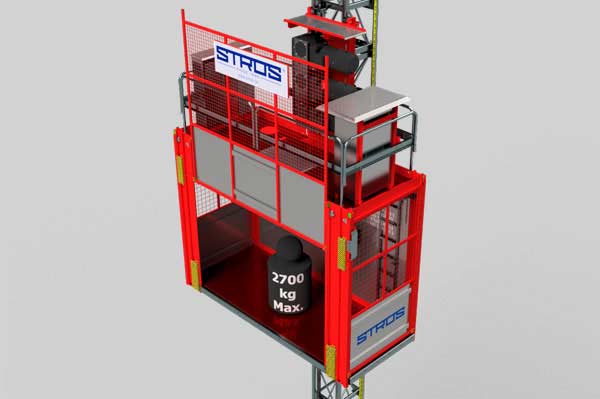
A construction hoist, often called a buck hoist or rack and pinion elevator, is the temporary vertical transport system installed on the exterior of a building under construction. These units move workers, tools, and materials between the ground and upper floors while the permanent elevators are still not operational.
Construction hoists get classified as material hoists, personnel hoists, or combination units rated for both. Twin mast configurations let two independent cars run on a shared tower, which raises throughput on projects with heavy trade traffic.
Industrial Elevators
Industrial elevators serve a different job. Instead of supporting a construction schedule, they provide permanent or long-term vertical transport inside facilities like cement plants, refineries, power generation stations, mining operations, and manufacturing sites.
This category includes material elevators built for heavy, continuous loads, personnel and material lifts, service elevators, temporary construction elevators for industrial retrofits, and explosion-proof elevators engineered for hazardous environments where standard electrical components aren’t permitted.
Building Maintenance Units and Facade Access
Once a structure is complete, it still needs a way to service its exterior. Building Maintenance Units, known as BMUs, are permanently installed facade access systems that carry maintenance crews to window washing, inspection, glazing repair, and envelope maintenance tasks on mid-rise and high-rise buildings.
Facade access has to be considered at the design stage. Retrofitting a BMU onto a completed building costs far more and causes far more headaches than designing it in from the start.
Gates, Enclosures, and Supporting Infrastructure
Vertical access isn’t complete without the supporting products that keep it safe and code-compliant. Ground and landing hoistway enclosures. Gates. Intercom systems for hoist-to-hoist and hoist-to-ground communication. Common towers that let multiple hoists share a single structure. Set-back tower configurations for buildings with stepped facades.
These components get overlooked constantly in early planning, and yet they directly affect both safety compliance and how efficiently a hoist can be loaded and dispatched.
Treat vertical access as one connected system, not a single hoist purchase or rental decision. That’s the first step toward getting the right equipment for your site.
Decision Factors When Selecting Hoist Construction Equipment
There’s no universal answer to which hoist, elevator, or facade access system fits a project. The right choice depends on a set of factors assessed together, not one at a time.
Site Height
Height determines tower configuration, car speed, and structural design. A low-rise project running under a year looks nothing like a super-high-rise tower above 1,000 feet, where wind loading, tie-in spacing, and car speed turn into critical engineering questions. UCEL construction hoists have proven out on sites with towers exceeding 1,000 feet, and that height brings additional requirements around structural bracing, mast climbing sequencing, and wind rating that shorter projects never deal with.
Load Requirements
Match the equipment to what you’re actually moving. A material-only hoist rated for pallets and equipment is a different unit entirely from a combination personnel and material hoist rated to carry workers safely alongside cargo.
Underestimating load requirements early is one of the most common reasons projects end up re-ordering equipment mid-build, and that costs both time and money.
Project Duration
Duration matters more than most people plan for up front. Short-duration projects favor rental. Multi-year builds, or facilities that need vertical access indefinitely, often justify a purchase instead.
Duration also shapes maintenance planning. A hoist running eighteen months on a high-rise needs a very different service cadence than a unit deployed six weeks on a low-rise renovation.
Construction vs. Industrial and Manufacturing
Construction projects need temporary systems that install, extend as the building rises, and come down once permanent elevators get commissioned.
Industrial and manufacturing sites need something else entirely, often permanent or semi-permanent elevators running continuously for years in demanding environments, from cement plants to oil and gas refineries to power generation facilities.
Some settings, like chemical processing or oil and gas operations, require explosion-proof elevators built to different electrical and mechanical standards than a standard construction hoist.
Buy vs. Rent
This decision comes down to duration, utilization, and total cost, not the sticker price on a single rental quote. Renting keeps capital available and shifts maintenance responsibility to the supplier, which fits most single-project timelines.
Buying makes sense for contractors running a continuous pipeline of projects, or industrial operators who need equipment available on demand for the life of a facility. UCEL supports both paths directly, offering construction lifts for sale alongside a rental fleet, so the decision rests on your project economics rather than what one supplier happens to offer.
Safety and Certification Baseline: ANSI, CSA, UL, and TUV
Certification isn’t paperwork. It’s the difference between equipment engineered and tested to a recognized standard and equipment that just looks similar. On a jobsite, that difference decides whether an inspection passes, whether insurance coverage applies, and whether workers go home safely at the end of a shift.
- ANSI (American National Standards Institute) sets the performance and safety requirements referenced across construction hoist and elevator codes in the United States.
- CSA (Canadian Standards Association) governs equipment safety requirements across Canadian jurisdictions and sets the baseline for hoist and elevator equipment operating in Canada.
- UL (Underwriters Laboratories) certification covers the electrical and component safety of hoist systems, which matters given how much of a hoist’s reliability comes down to its control systems and wiring.
- TUV is a European testing and certification mark verifying equipment meets rigorous mechanical and safety benchmarks before export for use in North America.
Equipment carrying certification across all four marks has been evaluated against the strictest requirements in each region it’s designed to serve, not just the minimum bar required to legally operate in one jurisdiction.
Why Certification Requirements Vary by Region
Canada and the Northeastern United States don’t apply identical rules. Provincial regulators in Canada reference CSA standards and, in many cases, layer on local elevating device requirements administered by provincial safety authorities.
In the Northeastern United States, ANSI standards apply nationally, but individual states and cities, dense urban markets like New York especially, add local code requirements, inspection schedules, and permitting rules on top of the ANSI baseline.
A hoist fully compliant in one province or state isn’t automatically compliant across a border. Which is exactly why working with a supplier who understands both regulatory environments matters more than it might seem at first glance.
Choosing equipment based on certification, rather than availability alone, isn’t optional. A rental hoist that meets only the minimum local legislative standard leaves you exposed if an inspector applies a stricter reading of the code, or if an incident occurs and the equipment’s certification history gets challenged.
UCEL’s rental fleet carries UL, ANSI, and CSA certification, and installation practices meet standards that exceed national and local requirements across every region UCEL serves.
The Cost of Skipping This Step
One installation mishap, or one missed maintenance interval, costs far more than the certification review would have. An inspector can shut down a non-compliant hoist mid-project, triggering schedule delays that ripple across every trade waiting on vertical access. Confirming certification before equipment arrives on site, not after, is the only way to avoid that risk entirely.
How Smart, Connected Hoist Technology Is Changing Uptime and Monitoring
Construction hoists have historically been mechanical systems monitored by hand, which means downtime often only surfaced after it had already cost hours of lost productivity.
That’s changing. UCEL has partnered with Smartsite to bring connected hoist technology to the Canadian market through the SmartHoist platform, a retrofit-ready system that layers monitoring, dispatch, and workforce tracking on top of existing hoist infrastructure.
What Smart Hoist Technology Actually Does
SmartHoist and the broader Smartsite ecosystem, which includes Smart Lift, Smart Worker, and Smart Floor, give site teams visibility into how hoists are actually being used in real time. Instead of relying on a hoist operator’s log or an end-of-day estimate, project managers can see wait times, car utilization, and floor-level demand as they happen. On projects using this technology, Smartsite has reported cutting hoist wait times by as much as 50 percent, saving tens of thousands of labor hours, and accelerating project delivery timelines by as much as three weeks.
Why This Matters for Uptime
Unplanned downtime is consistently the biggest cost driver on any vertical access equipment, rented construction hoist or permanently installed industrial elevator alike.
A hoist down for even part of a shift stalls every trade waiting to move materials or personnel through it. Connected monitoring shortens the gap between a developing problem and a technician response, since issues get flagged before they turn into full breakdowns.
That shift from reactive to proactive maintenance is the single biggest advantage smart hoist technology brings to a jobsite.
Retrofitting Existing Equipment
Since SmartHoist is plug-and-play, it doesn’t require replacing hoist equipment already on site. That matters for contractors managing mixed fleets or long-running projects who want the monitoring benefit without re-equipping mid-build.
As sites move toward digital project management more broadly, connected hoist data becomes another input alongside scheduling and trade coordination software, not a standalone system sitting off to the side.
Why Equipment Choice Affects Total Project Cost, Not Just Rental Price
The monthly rental rate on a quote is the first number everyone compares, and it’s often the wrong number to anchor a decision on. A lower rate on paper can end up costing more once you factor in downtime, service response delays, and rework from an undersized or poorly maintained unit.
Consider what a single day of hoist downtime actually costs. A modest gap between rental rates, even a difference of roughly a thousand dollars a month, gets dwarfed by the cost of one day where the hoist isn’t running and every trade depending on it sits idle.
Labour crews standing by. Material deliveries stacking up at the ground level. Schedule slippage that pushes back every trade behind it. It compounds fast.
Total cost of ownership, not the line-item rental price, is what should drive equipment decisions. Here’s what actually shapes it:
- Maintenance quality: Equipment that has been through a proper refurbishment cycle between projects fails less often than equipment rented out without a consistent service program.
- Response time: A supplier who gets a technician to site within hours, not days, limits how much a mechanical issue actually costs you in lost productivity.
- Fleet condition: since older or poorly maintained units may carry a lower headline rate but a higher failure rate across the life of the rental
- Inclusive service terms: that bundle maintenance into the quotation, avoiding the surprise charges that show up when a supplier treats service as a separate, billable add-on
- Right-sizing: Undersized equipment creates bottlenecks that slow the entire project, even if the unit itself never breaks down
UCEL builds service and maintenance into rental quotations directly, so there shouldn’t be surprise charges layered onto a poorly maintained piece of equipment.
Rental fleet units go through an in-house refurbishment center after each project, and UCEL maintains an in-house test tower to verify equipment before it goes back into service. Component replacement and repair work happens in UCEL’s shop, not on your jobsite, which keeps unplanned repair time off your critical path.
For industrial and permanent elevator applications, this calculation stretches across years, not months.
A life-cycle maintenance schedule that anticipates component wear reduces the cost of unplanned failures far more effectively than reactive repairs after a breakdown already happened.
So, locked-in contract pricing on service and maintenance gives facility operators a fixed number to budget against, instead of an open-ended repair bill that shifts year to year.
How to Evaluate a Vertical Access Partner
The equipment itself is only half the decision. Who you buy or rent it from decides whether that equipment performs the way it’s supposed to over the life of the project.
Service Response Time
Ask directly how quickly a technician can get to site after a call, and ask for that answer in hours, not a general assurance. Response time matters most in the moment a hoist goes down mid-shift, when every hour of delay compounds against the schedule.
Suppliers with a strong technician bench and local branch coverage typically respond faster than suppliers dispatching from a single, distant location.
Fleet Condition And Maintenance Practices
Ask what happens to equipment between rentals. A supplier that runs every unit through a refurbishment and testing process before sending it back out is a fundamentally different partner than one that just cleans a unit and re-rents it.
Local Presence Across the Regions You Build In
Local presence changes how fast you get help. A supplier with full-service branches across the regions you operate in, rather than a single head office serving a wide territory remotely, gets you faster access to parts, technicians, and equipment.
Track Record on Comparable Projects
Track record on comparable projects tells you almost everything else you need to know. Ask for examples of projects at a similar height, industry, or complexity to yours.
A supplier that has repeatedly delivered on demanding, high-rise, or industrial sites has already worked through the engineering and logistics challenges your project is likely to face.
UCEL has supplied vertical access equipment on 11 of Toronto’s 20 tallest buildings, along with large-scale hoist deployments on major projects including Hudson Yards and 220 Central Park South in New York City, and industrial installations including Amazon’s Project Python facility.
Design and Consultation Support
The strongest vertical access partners get involved before the equipment order goes in, not after. Reviewing site constraints, load requirements, and jurisdictional certification needs during the design and consultation stage prevents the kind of last-minute equipment substitutions that cost time and money later.
Manufacturing Partnerships
Where the equipment is built, and to what standard, is worth checking too. UCEL works exclusively with a leading European manufacturer whose equipment is built in an ISO 9001-certified facility, using European steel and components engineered specifically for the North American market. Over 1,000 units built through this partnership currently operate across North America, a scale that reflects a proven, long-term manufacturing relationship rather than a one-off supply agreement.
Why Planning Vertical Access Early Protects Your Project
Height, load, duration, industry, certification, technology, cost, or partner selection. Every factor in this guide points to the same conclusion. Vertical access decisions made early and deliberately protect a project’s schedule and budget far more effectively than decisions made reactively once equipment is already needed on site.
Waiting until a hoist is urgently required narrows your options to whatever is available. Not necessarily what’s right for the job.
If your next project involves a construction elevator, material elevator, industrial elevator, or facade access system, have the planning conversation before the schedule forces your hand.
Contact UCEL Inc. to review your site’s height, load, duration, and certification requirements, and build a vertical access plan suited to your project instead of whatever equipment happens to be available on short notice.
Frequently Asked Questions
Should I rent or buy hoist equipment for my project?
Renting suits single projects and shorter timelines. Buying suits contractors running continuous projects or industrial operators needing equipment available for the life of a facility.
Why do certification requirements differ between Canada and the Northeastern United States?
Canada applies CSA standards with provincial regulations layered on top. The Northeastern United States applies ANSI standards with added state and city-level code requirements.
How does smart hoist technology reduce project costs?
Connected platforms like SmartHoist flag maintenance issues before they cause breakdowns and track wait times, helping cut downtime and improve scheduling across the site.
What should I ask a vertical access supplier before signing a contract?
Ask about technician response time, fleet maintenance practices, local branch presence, equipment certifications, and whether service is included in the rental quotation.
What is the difference between a material hoist and a personnel hoist?
A material hoist moves supplies only and should never carry workers. A personnel hoist is built with safety features specifically for transporting people between levels.
What determines how much weight a construction hoist can carry?
Load capacity depends on the hoist's mast, car structure, drive system, and safety mechanisms, engineered to match the project's height and heaviest anticipated load.
How often should a construction hoist be inspected?
Hoists need a documented pre-use inspection before every shift, plus scheduled maintenance inspections at intervals set by the manufacturer and local regulatory requirements.
What is a Building Maintenance Unit and when does a building need one?
A BMU is a permanent facade access system for exterior maintenance on mid-rise and high-rise buildings. It should be planned during design, not after construction.
How far in advance should vertical access equipment be ordered for a project?
During the design and consultation phase, before construction begins. Height, load, and certification requirements affect availability and how long equipment takes to prepare.